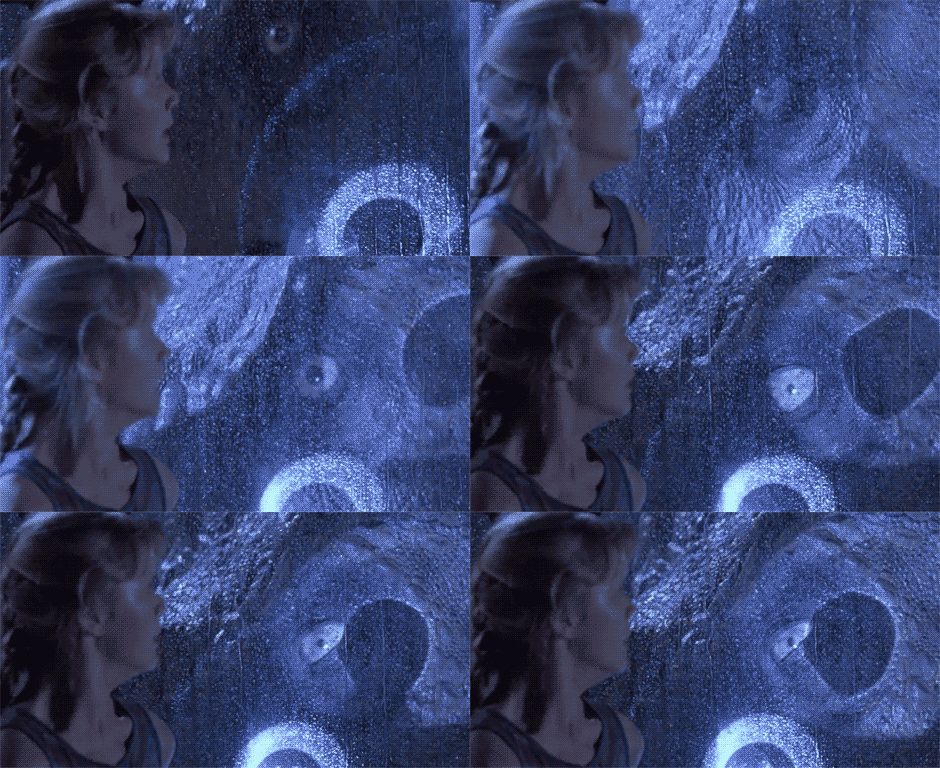
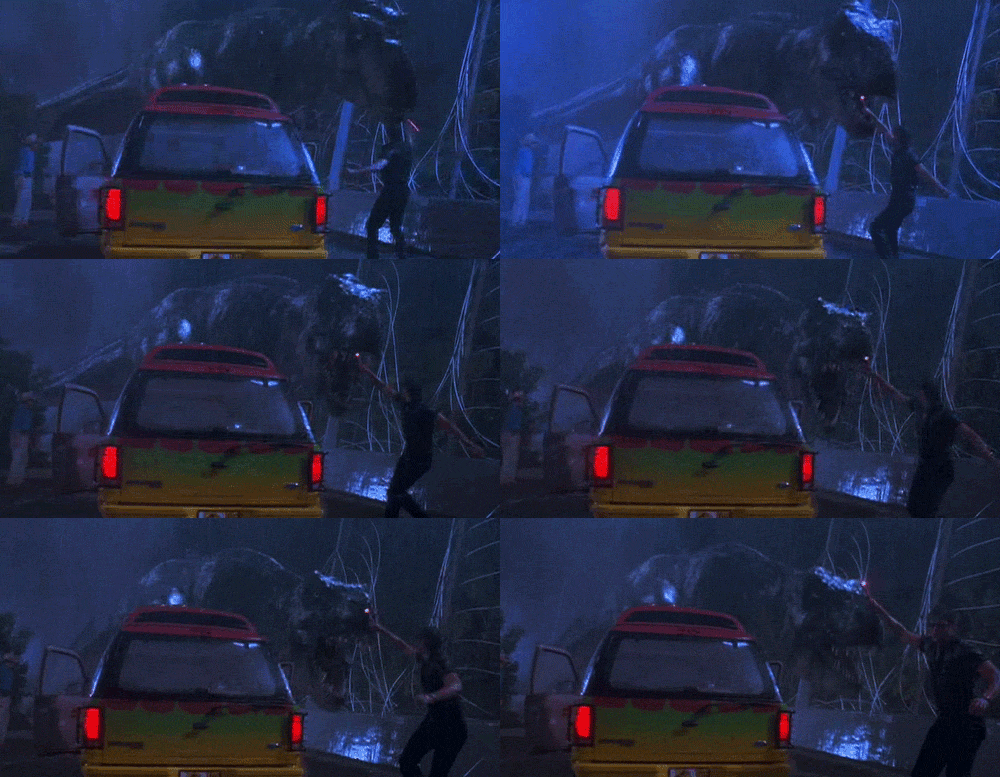
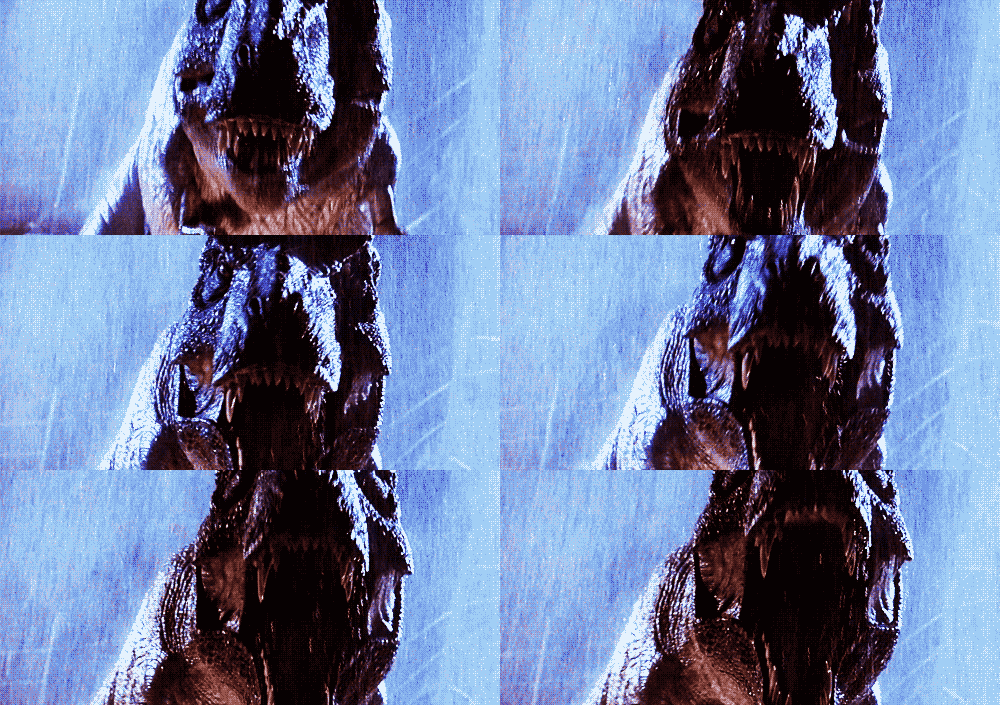
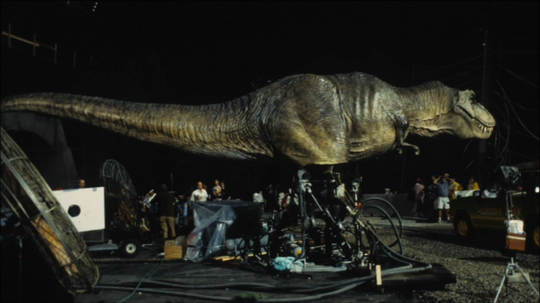
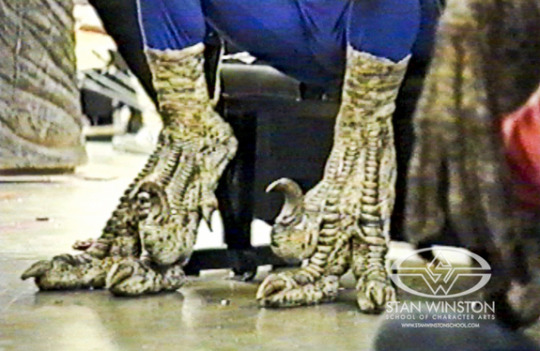
Remember in 1993 when Jurassic Park was like…the end all, be all of special effects?
not gonna lie that still looks intimately real
I’m still somewhat convinced that someone sold their soul to create the special effects in Jurassic Park because that shit is over 20 years old and it still really, really holds up, better than the stuff in a lot of current movies, even.
Fucking witchcraft, man.
fucking look at this shit though
Literally see this post flying around with a few different responses added to the bottom each time so I’ll say it for this one myself:
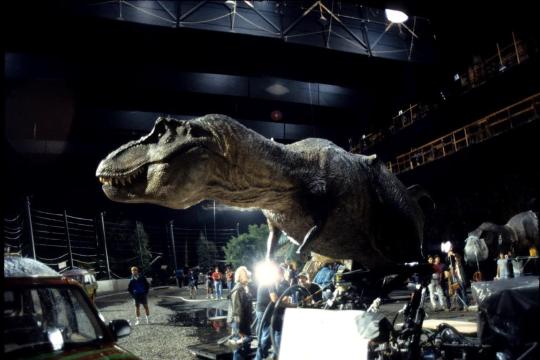
THEY ACTUALLY BUILT A GIANT MASSIVELY DETAILED FUCKING ANIMATRONIC T-REX FOR ALL OF THIS THAT’S WHY THE EFFECTS ARE SO GOOD. CAUSE IT AIN’T CGI. AND IT AIN’T GUY IN A COSTUME. IT’S A BIG FUCKING ROBOT DINOSAUR. AND EVERY PART IS DESIGNED TO MOVE. IT COST LIKE HALF THE BUDGET OF THE FILM.
amazing
And they had the film it in small increments, especially in the outdoor scenes, because the rain fall kept soaking into the ‘skin’ of the rex and would slow down and mess up its movements. So they would stop filming and have a crew out there drying off this massive, fake dinosaur, and then they’d start filming again until it was too wet. Repeat until the end of the scene.
They used animatronics and detailed costumes for most if not all of the dinosaurs in the first movie.
The triceratops for instance, was also animatronic.
One of my favorite anecdotes I’ve read on tumblr is how the t-rex robot from Jurassic park would malfunction while it was drying out. How did it malfunction, you might wonder?
Motherfucker randomly started moving.
So apparently if you were on the jp set you would sometimes hear people screaming bloody murder even though they were all well aware that it was a giant animatronic puppet and wouldn’t actually, you know, eat them.
Did not know this, had to reblog for awesome movie history insights.
So, I knew about the animatronics bit but I did not know the raptors were guys in suits and the malfunctioning t-rex sounds terrifying.
And i just googled malfunctioning t-rexand was not disappointed. Apparently in order to put the skin on over the steel frame a guy had to crawl inside thet-rex while it was turned on and glue the skin down. And if somebody turned the t-rex off or the power went out the guy in the t-rex stood a very real chance of getting mangled and killed by the hydraulics.
So of course, the power goes out.
And this guy is still in there gluing the skin down.
Apparently the way to survive getting sheered to death by huge sheets of metal while you’re inside a giant t-rex robot is to curl into a ball and hope for the best.
And this guy hoped for the best and got it.
Some other people on stage pried open the t-rex jaws and glue guy crawled out of its mouth and was totally okay.
This is getting better and better.
I think they only had like 6 minutes of CGI
I’m just waiting for the T-Rex to come to life and leave its stand.
The thing about this that gets my special effects nerd going is the fact that EVERY single dinosaur was sculpted by artists based on the current existent archeological evidence of the time.
Even better than that, this movie ADVANCED our best understanding of dinosaurs at the time. They were blowing out a budget bigger than anything Hollywood had ever seen, and along with employing almost the last hurrah of incredible physical FX, they had a bank of those newfangled digital SFX computers. Nobody’d ever really created convincing dinosaurs in a movie before. It’d all been stop-motion animation, and even when the models were exquisitely crafted, you could just tell there was something OFF about them. Spielberg wanted THE BEST DINOSAURS EVER, and he figured on using the cutting edge of digital modeling and animation technology to build them for him.
So they got hold of some of the best paleontologists they could find and said, “We want you guys to take this tech that your labs could pretty much never afford and use it to build us the most realistic, accurate dinosaur models the world has ever seen.”
The paleontologists knew an opportunity when it bit them in the ass. They plugged in everything they knew about dinosaurs, all the skeletons and their best guesses about soft tissue and all that. And when they’d created those dinosaur models, they had the computer start moving them as they realistically would with anatomy like that. One guy took a look at those walking t-rexes and velociraptors (really utahraptors, but whatevs, fam), and he said, “Wait a minute, I’ve seen movement like that before.”
He called up film of a chicken walking. Everyone in the room said, “Holy shit.”
Prior to 1989, the idea that birds were descended from dinosaurs existed–we knew about archaeopteryx, we knew there was some minor connection there–but the idea that DINOSAURS LIVE IN THE MODERN WORLD AND THEY ARE CALLED BIRDS was not pre-eminent. Jurassic Park changed our scientific understanding of dinosaurs.
That paleontologists’d be Kevin Padian. Who is awesome.
For those who are new to the sortinghatchats system, our basics post is here. But to sum it up: the way we play this game, your “primary” house is WHY you do things and your “secondary” house is HOW.
We just really like defining our terms, okay. It makes us happy.
Lito is probably the easiest of the lot to sort– a Slytherin Primary and Slytherin Secondary who uses both these aspects of himself to survive, thrive, and find joy. As a Slytherin Primary, his first priorities are himself and the people he loves– a short list that tentatively grows over the course of the series. Lito’s journey is, among other things, the story of a young Slytherin coming into his own as a responsible agent. Lito wants things, selfishly and emotionally– he loves in the same way.
It is not Dani or the horror of her situation that drive Lito to make his decisions at the end of season one, but Hernando’s leaving. Dani’s situation threw Lito into angst and chaos, but he stood by his priorities– his career, his privacy, and his comfortable life. Hernando, both braver and then fonder of Dani than Lito, was the catalyst that pushes Lito to overthrow his entire world to be brave.
(By season two, however, Dani is solidly in Lito’s deepest circles of loyalty. She’s family, then, and if the plot of season one repeated somehow, it would go rather different.)
Lito’s Slytherin secondary is also fairly obvious, as he’s the sensate called on whenever someone needs a lie, a distraction, or a bit of help with overdramatics. His acting is not just a job and a skill, but something he finds deep joy, validation, and power in. It’s an important part of his personality– his ability to shift, perform, and transform.
Hernando, Lito’s boyfriend, is a Ravenclaw Primary, a contrast which causes both conflict and growth in their relationship. Deliberate, confident, kind, and cerebral, Hernando provides both practical ballast and a call to bravery for Lito– in turn, Lito’s passion, ambition, and flexibility make Hernando’s life a better, brighter place. But when it came down to a choice between staying with the man he loved, or refusing to be complicit, however indirectly, in terrible things, Hernando chose to walk away– and Lito, bless his heart, chose to follow.
(I would also acquiesce rather quickly to claims that Hernando is actually just a very “smart-flavored” Gryffindor).
Hernando loves Lito’s playful Slytherin Secondary, though his is a little quieter– a Hufflepuff Secondary. He loves Lito by waiting for him, by showing up and being present and waiting for him to be brave. He eventually acts as catalyst to change his and Lito’s world not by convincing, persuading, discussing, or charging at the issue but by simply walking away. Hufflepuff secondaries are often overlooked but often form the backbone or bedrock of whatever communities or efforts they support. By leaving, Hernando yanks the rug out from under Lito’s feet and forces him to learn how to stand.
Look also at how he pulls off the scene when his asshole student projects the pictures of him and Lito. He takes in the attack, and then with a patient confidence uses all his knowledge and skill as an academic and a lecturer to reclaim and transform the moment. He turns something meant to shame him into a moment of pride and beauty, while calmly forcing the attacker to shrink in shame of his own making. In spaces that Hernando has embodied and built– his home and relationship, his classroom– he can wield an immense and debilitating power, underestimated by those who expect strength to be something more straightforward and aggressive.
Dani is a Slytherin Primary as well, though I dither about her secondary– either Hufflepuff or Slytherin. Whichever one she doesn’t have, she occasionally pretends she does. I think she’s a Hufflepuff secondary (look at how she gets Lito the interview in Hollywood), but with a convincing veneer of Slytherin. She’s the “well I know a guy” version of the Hufflepuff secondary– at her happiest she is thriving and succeeding using the connections and knowhow she’s gathered, all in the service of people she loves.
Wolfgang is another Slytherin Primary– unlike Lito, who had to recalibrate to lift Hernando’s needs (and Dani’s) above his own ambitions, Wolfy is more likely to need to remember to value his own needs and wants. In some ways, he’s got a parallel arc with Kala, there, as she too goes on a journey to accept that she wants and that sometimes she can have and that doesn’t make her evil.
When we meet Wolfy, the only person he cares about is Felix, his scrappy, loyal best friend who I like to imagine one day gets to meet Capheus and watch terrible B action movies with him. Wolfy’s Slytherin primary is fairly obvious to any character with eyes, ears, or a brain stem, and so various plots around him turn on that loyalty– hurting Felix to punish Wolfy, rewarding him to court Wolfy. It’s a character role more often given to the sweet beloved and it’s rather delightful to see that dynamic play out with the gangly, startled Felix, who doesn’t understand how important he is.
Wolfy’s secondary is Hufflepuff– the house of patience and toil. A deliberate and reserved fellow, Wolfy just keeps going until he either breaks or succeeds. One of the assets being a sensate provides him is that he can borrow others’ flexibilities (or, rather, have those flexibilities anxiously thrust at him, when he seems on the verge of breaking). He and Lito serve each other especially well in this respect, with Lito stepping in to lie and maneuver when a flexible hand is needed, and Wolfy stepping in for Lito when he needs to stand in front of an oncoming force and refuse to budge, bow, or back away.
Kala, a Ravenclaw secondary, complements as opposed to supplements Wolfy’s secondary skills. When Wolfy’s resources and opportunities run low during his methodical murder of the men who almost killed Felix in season one’s climax, Kala steps in to provide additional destructive ballast in the form of kitchen sink explosives. Where Wolfy is terminator-level stubborn, carrying a host of earned skills and some terrifying patience to the battleground, Kala is prepared, inquisitive, and quick-thinking. As they both came into their own, and as they learned to lean on each other and trade strengths and skills, I think the pair of them would have turned into an even more terrifying duo of persistence predators.
Kala’s a Gryffindor Primary who’s interacted with very few real dilemmas in her life. She feels things strongly and with certainty, despite her lingering doubts about her ability to be a good person and to know wrong from right. It’s that strong desire to be good, to know what the right thing is and to do it, that marks her as a Gryffindor. She’s someone who cares about being passionate, righteous, and good, but she’s never had an enemy force to charge or a thorny path to defy. She’s always known what the sensible next step was– love her family, go to university, marry the nice man who loves her– but as she grows older she can tell there’s something missing. She keeps doing the “right” things, but she doesn’t care, and she wants so badly to care.
She worries she’s “bad,” maybe even just amoral, but the fact that this upsets her contradicts her worries– as does the fact that, when moral quandaries she does care about thump down at her feet, she reacts with immediate moral certainty. When she learns about the unethical activities of Rajan’s pharmaceutical company, her response is instant and righteous. It is wrong, she knows it, and she won’t stand for it. When shit hits the fan, Kala doesn’t dither or hesitate.
Despite that, much of her first season of story arc is Kala doing just that– dithering and hesitating over questions of love, fidelity, and marriage. She knows what’s supposed to happen, what she’s supposed to want, and she sits for most of the season in the middle of that quandary. On first glance, Kala can even look like a “burned” Gryffindor: someone who cares deeply about doing the right thing, but has lost their faith in their own intuition or goodness– or even in the idea of right and wrong itself.
But Kala’s not “burned” or frightened– rather, she’s just sort of morally bored.
Doing what is right and good matters to her, and Kala is passionate and unflinching when it comes to those big questions– and marrying and loving Rajan should be one of those big questions. The thing is– it’s not. Not for Kala, and so she’s left in a tremulous in-between where she can’t rely on her gut, instincts, or desires to drive her to action.
Kala has never really wanted anything before. She’s never had big, important decisions thrown at her feet, and she’s intellectually certain this marriage thing should probably be a big deal. But no matter how she struggles to care about this and make a decision that comes from the heart, she can’t force it on herself. The inability to care here and to act intuitively makes her feel adrift and insincere. It’s not just that she’s not passionate about marrying Rajan– she’s not even passionate about not marrying him. It’s all a wash. Adultery, psychic or otherwise, is something that Kala vaguely thinks she should care about– but she doesn’t.
(Rajan, like Wolfy and Dani, is a Slytherin/Hufflepuff– he cares first and foremost about the people he loves, and he’s even fairly good at it, caring for Kala warmly and respectfully.
Like Lito, Dani, and Wolfy, Rajan’s a Slytherin primary who hasn’t really bothered supplementing his “me and mine” morality with some sort of additional, larger set of guidelines. He wants to be okay, he wants Kala to be okay, and he likes to be nice. His quick and actual turn-around on the malevolent pharmaceutical practices is an aspect of his Slytherin– his wife cares and so as soon as he has time to digest her emotions, he cares, too, and morever, he acts in an immediate and effective way. It’s not even that he’s doing that to make Kala happy– it’s that it matters to Kala and therefore it is important and right.
His Hufflepuff secondary shows in the company he’s inherited and the ways he’s invested and buried in its mechanisms, his ability to play well with others without ever seeming to “transform” to do so (in the way a Slytherin secondary would), and his patient, kind courtship of Kala.)
In the style of Katniss Everdeen, the inspiring power of Capheus’s Gryffindor secondary astonishes him with both the quality and quantity of its effect. Gryffindor secondaries with such political and televised presences can becomes “figures” instead of people– despite their “realness” often being what the masses like and respond to in them. Capheus, like Katniss volunteering for Prim or mourning Rue, is just being himself– but it makes him into Van Damn the same way Katniss became the Mockingjay.
Capheus is good, and he believes in things until they happen. “I think it’s going to be a really good day,” he says. Capheus’s faith is something that can and does change his world. It’s the same thing that inspires even his enemies to like him– like the fellow who came to warn him mid-season 2 and promised him his vote if he lived.
On the primary side: Capheus has a strong and emotional sense of right and wrong, but also a willingness to hold himself away from things he think he cannot change. But, as he becomes more aware of his own power and how he might affect the world, he finds it impossible to keep himself in the shadows. He is like his father, which he and his mother fight about. Capheus cannot sit still when the world is broken and (and the “and” here is important) when he thinks he can change that world for the better. Like much of the cast, he’s a Gryffindor primary, who holds a strong and kind internal compass in his chest.
Losing her mother, her burdens dropped soundly on her young shoulders, left Sun growing up with a yawning absence and a sense of always trying to play catch-up. She was supposed to be her mother, to care for her brother, despite being a child herself. As an adult, she blames herself for her brother’s crimes and feels guilt for not being “good” enough– for not being who and what she was supposed to be.
Sun tries to build herself into what she thinks she should be– but she is at her strongest and most joyous when she is being what she is and just acting. There is a sense, with Sun, that she is always holding back– from that first clenched fist in her opening scene in the pilot to the moment she bursts into potentially murderous action in the season two climax. She has trouble trusting herself enough to act on her instincts– a “burned” Gryffindor who doesn’t believe in her own goodness, value, or strength– except for single spark-bright moments when she does. This might be why she likes fighting so much– for an instant, in the ring, she knows exactly what she needs to do and she does it unflinching. After a season of considering, dithering, and thinking, she makes the snap decision in the climax of season two to go after her brother and it is a release and a culmination.
Sun tries to use reason and logic, a Ravenclaw’s tools, to supplement for her lack of faith in her Gryffindor. Her mother gave her that initial rule— take care of your brother. And she does: we see in the beginning of season one how aware she is of where her brother’s likely haunts are, how practiced she is at finding him. She carries her position in the company with grace and conviction even when having to deal with sexists who dismiss her. When considering whether or not to take the fall for her brother, she doesn’t listen to her gut screaming against it but instead walks and thinks and tries to use her reason to convince herself it is the right thing to do. She continues on trying to follow her mother’s gift of a system– take care of your brother– at the expense of everything she has.
The Sun who leaves the prison is different from the lonely young woman who entered it– this “new” Sun would never had given up her life for her brother’s. After friendship, connection, and support from the other inmates (and her fellow sensates), Sun is far more convinced of her own value and her own right to freedom. After her mother’s death, her father’s distance, and the adult-sized burdens she’s carried since childhood, Sun before this lacked any evidence that she was worth something to anyone.
Painting with her friends, conversation, and camaraderie were all influential in changing Sun’s view of her value, but one of the most influential moments was when the guards were killing her and her friend came to her rescue. Sun, a Gryffindor secondary, believes in action more than words, and that was certainly a clear-cut message about what her friend thought Sun’s life was worth. As she heals throughout the story, she swaps out some of logic she uses to guilt herself instead for the faith her friends have in her.
Those friends also give a nod to Sun’s secondary– Hufflepuff. It is the work, patience, and time Sun has put into things that pay out in the end for her. This is as true in her fighting as it is in the kindnesses she pays to others. Her teacher, her inmate friends, and the cop with the crush on her are all examples of this– anyone who knows Sun knows she is good– so good they are all willing to fight for her in their own ways. Her teacher hides her. Her inmate friends support her and even kill for her. The cop, who has seen her grit and goodness exactly once, immediately believes her and wants to be on her side. Similarly, it is years of patience and toil that have left her talented and powerful as a fighter.
Riley is very tired and very sad, and that makes her sorting complex from the outside. Whatever her primary is, it’s burned to almost a crisp. She’s not a Slytherin, who prioritizes personal loyalties and obligations first. “Burned” Slytherins try to cut off all their emotional ties for self-protection, but Riley has no angst or barrier around caring for people, despite her losses. The same goes for Hufflepuff, the other “loyalist” House. Hufflepuffs care in a broader and fairer way than Slytherins, but the heart of it is still connection and obligation. “Burned” Hufflepuffs also try to limit their caring, exhausted and aching, and we don’t see that with Riley. She doesn’t seem to be avoiding connection when she’s hurting, and as she heals over the course of the series she doesn’t leap for and glory in the new connections she builds and accepts.
This leaves as options a “burned” Gryffindor or Ravenclaw, the two “idealist” Houses. Gryffindors value their gut where Ravenclaws value their reason– when a Gryffindor “burns,” they lose faith in their ability to know what’s right, to feel it, and to trust their intuition. When a Ravenclaw “burns,” they lose faith in their ability to think, assess, understand, comprehend, or decide. As Riley heals and comes into her own in season two, she seems to glory in her own growing faith in her inner compass. There is a delight in knowing her path and sinking her teeth into a fight that is particularly Gryffindor.
Additionally, like many young women who fall into the “manic pixie dream girl” mold, Riley is a Gryffindor secondary. Creative and genuine, the way she unflinchingly embodies what she does is apparent especially in her music and its reported effects on people. People are drawn to Riley, whether she wants them or not. She has a “shine” that’s exhausting, illuminating, and powerful. It’s what drew that one slick, creepy drug dealer’s notice, and also what lets her charm and win over our grumpy Scottish sensate friend. When entrenched in the paranoia of the sensate community, Riley cracks open their defenses with a moment of brave and risky honesty–letting him see where she and Will are–and, what’s more, he believes her when she does it.
Will, despite having one of the spottier character consistencies in the story, settles pretty soundly as a Hufflepuff Primary/Ravenclaw Secondary. He’s a loyal, dependable kid who hangs a lot of his identity and worth on his allegiance to groups and families– he’s a cop, he’s a sensate, and both these groups matter enormously to his self-image. He’s torn between those loyalties– abandoning his partner and his father, his obligations to his new sensate family. Of the cast, he’s by far the most sympathetic to Whispers, who is “like them.”
Will’s best skills are showcased in his early season two interactions with Whispers, when he plays Sherlock to identify where the holding cell is, gathering data, pulling information out of Whispers’s shoes and wall outlets, and extrapolating onward. He pulls long cons (pretending they were still in Iceland, etc) or detailed, sturdy plans. He likes prep, experience, and back up– he hates it when Riley has to go off on her own to Chicago without him or any fallbacks, but Gryffindor Riley delights in the movement. He’s a cop-flavored Ravenclaw Secondary, and effective with it.
Nomi’s yet another Gryffindor Primary in this cluster of Gryffindors. She has a strong and intuitive sense of right and wrong, something that drives her to make good and effective changes in the world. Stepping in to take the fall for Bug was a practical and selfless move that she carries with her humbly. She’s the kind of person who might claim and believe that “anyone would have done the same.”
It’s also something, however, that can lead her to neglect anything outside her cause of the moment. Nomi can get tunnel vision, such as when she abandons her sister at the dress fitting, not even waiting to hear the end of Teagan’s question. Nomi is deeply invested in whatever her highest priority is, which makes her an effective agent in the plot, but which also means she can abandon things (at least temporarily) that do genuinely mean the world to her. She loves her sister, but they got news about Angelica’s cabin and that takes priority in that moment.
Nomi can’t do things in halves– she’s all in, or she’ll have to get back to you later. Her sister, who seems to be a loyalist house (either Hufflepuff or Slytherin) is thrown off and disappointed by what surely feels to her to be a lack of Nomi’s affection (and certainly is a lack of Nomi’s attention)– but in the tradition of a good loyalist, Teagan seems to be always willing to be there when Nomi pops back into her life.
There’s a certainty and validation, as well as a mutual awe, that Nomi and Amanita find in each other here. Both Gryffindor Primaries, they supplement and support each other in the context of a larger and often disappointing world. In a bold Gryffindor way (Amanita is a Gryffindor secondary, as well as a primary), they make their own magic, joy, and beauty. Whether in the eclectic, personal space of their home, escaping a hospital in the back of a cab, sharing fries and pot brownies, or kissing in the forest where Angelica once burned down her own home and killed a man doing it, Amanita and Nomi light the scene themselves. They’re self-sufficient and self-motivated and self-soothing, burning from the inside out in ways they recognize in each other.
They approach situations differently in terms of methods– aka the secondary. Amanita is a beauty of a Gryffindor/Gryffindor, a sorting the writers seem to especially adore and respect. She is confrontational, brave, protective, and throws all of herself into everything she does– a set of methods that work out for her every time. She likes attention (“costume opportunity!”) for a good cause. She doesn’t maneuver, hedge, or negotiate when something is wrong in front of her– she tells off her ex-friend for her transphobia at their first Pride, she sets fire to the hospital as a distraction, breaks into the surgeon’s apartment with unconstrained glee, bursts into the aisle of Teagan’s interrupted wedding, and in general dives headfirst into the dangerous plot of Nomi’s new life.
Nomi, though also a Gryffindor primary, is quieter on the secondary. Nearly all her best successes come from years of work and her ability to humbly and truly mean the things she does. Friends hide Nomi and Amanita because of old favors and generosity on their parts. Bug turns over his whole life for them, because once Nomi turned over her whole life for him. There is a sense of fairness here. Talented and generous, Nomi’s yet another super-powered Hufflepuff secondary in the cluster. For a story that so loves the idea of skill-set-swapping and community, it makes sense there’d be an un-self-conscious love of the puff.
tl;dr the cluster: Sun – Gryffindor/Hufflepuff (burned) Nomi – Gryffindor/Hufflepuff Lito – Slytherin/Slytherin Will – Hufflepuff/Ravenclaw Capheus – Gryffindor/Gryffindor Riley – Gryffindor/Gryffindor (burned) Kala – Gryffindor/Ravenclaw Wolfy – Slytherin/Hufflepuff
a selection of non sensates; Amanita – Gryffindor/Gryffindor Hernando – Ravenclaw/Hufflepuff Daniella – Slytherin/Hufflepuff Rajan – Slytherin/Hufflepuff
you: blah blah blah mug cakes always turn out bad
me: add salt. i know it’s a sweet thing but you have to add salt just trust me. also cut the cooking time in half. yes. half. i have made mug cakes with just thirty seconds in the microwave. the result will be gooey and delicious
“But Alpha, purple is simply not appropriate.” Quinn’s growly voice somehow edged into whining.
The rest of the werewolf pack tried to shush him, but the damage was done.
“I beg your pardon!” Sandalio de Rabiffano, newly minted
Lord Falmouth, better known to the rarified fuzz and fang of the
supernatural set as Biffy, Alpha of the London Pack, nearly leapt to his
feet… at the dinner table. He was that offended. Of course, he
remembered himself long before he could commit such a profound breach
of etiquette. He was, after all, still Biffy.
He narrowed his eyes instead. “I assure you, purple is a perfectly
delightful color and is more than appropriate to all venues, ages,
genders, and species!”
“It doesn’t hearken to nature,” Phelan came to his pack mate’s
defense with an intellectual argument. He cocked his head socratically,
his studied air rather defeated by the fact that he had to stop stuffing
his face with steak and kidney pie in order to talk. Biffy swung his
discerning glare onto him, judging his manner, his decision to speak
against his Alpha, his choice of argument, and his ill-judged belief
that Quinn had opened the floodgates of objection.
This anti-purple rhetoric would be nipped, most sharply, in the bud.
“Plenty of lovely natural things are purple: sunsets, sunrises for that
matter, iris, aubergines, oysters.” Nip nip nip! “Although” – he
frowned, and then remembered he didn’t like the way this wrinkled his
forehead, so stopped – “these are all different shades of purple. Is that the true objection? Should I choose a different shade?”
A chorus of groans met that. They’d already been at this for an hour,
Biffy finally settling on this particular deep, rich, dark plum velvet.
Ordinarily, the pack didn’t care about interior decorations and would
rather he choose without involving them. Ordinarily, he would have. But
this was a communal curtain situation and they were his pack. Curtains
should matter to his pack. And now, it seemed, of a sudden they did matter.
Biffy pursed his lips. He knew this was the correct color.
Knew it in his very bones. Bones that moved and shifted and broke every
full moon, so possibly not as reliable as they might once have been, but
still… “Why are you arguing with me on this particular detail? Purple
would suit the room best. You never usually care two tail shakes for
this sort of thing.” Why object now about something I know is right?
Adelphus, who was at that moment wearing a purple evening jacket (not
plum, more violet, but still), looked monumentally uncomfortable. He
fiddled with one of the fabric samples set out before them. Biffy
suppressed the instinct to slap the man’s hand away – Adelphus might
leave a grease stain. But no, it was fine, Adelphus was mostly tame. “I
simply feel the green…”
“In that room? Are you mad?” Biffy tried not to let the frustration
color his voice. He knew what he was talking about. This was what he
did. He made rooms beautiful. He made people beautiful. Or he used to,
before he lost most of his soul and creativity.
Doubt, his old friend, shook him then. Maybe I’m wrong. Maybe the
purple is unpleasant. Maybe I’ve lost my eye for color as well as
everything else. No. Stop second-guessing. It’s the purple or nothing. And nothing was not an option in a house full of werewolves. Sunlight being rather more of an issue when one was allergic to it.
He took a breath. I’m the Alpha, for goodness’ sake. Aren’t they supposed to listen to me? Instinctively obey me?
“God’s teeth, it’s only curtains!” Even Rafe, the most easygoing of the pack, was getting annoyed.
Biffy huffed. “Curtains,” he explained slowly as though to a very
thick child (which, to be fair, rather defined Rafe’s character), “are a
serious business.”
“Don’t you think they’ll be too dark for the room?” Hemming was
clearly not at all sure of himself. It sounded as if he were trying to
come up with an excuse. As if he really had some other reason for
objecting. As if they all did.
What is going on here?
Biffy swept a critical gaze over his nervous pack. “All right, chaps, what’s the truth here? What’s actually wrong with purple?”
His pack all looked collectively guilty. They exchanged glances.
Finally, they all turned to Adelphus as if he were the one best at
calming their new, young, purple-minded Alpha.
Poor Adelphus. He isn’t my Beta, but he keeps getting cast in that role. Biffy
winced away from that thought, like touching a sore tooth. He didn’t
want to think about his Beta. He didn’t want to miss him.
He’d agree with me about the purple.
A nice dark plum, ideal to show off the daring ash furniture and
sumptuous cream brocades he’d chosen for the rest of the drawing room.
With some luscious ferns scattered about, and a few other plants,
shelves of books, and other knickknacks. It would look rich and striking
yet bright and welcoming and…
Adelphus looked uncomfortable. But at least he’s stylish. Perhaps I should listen to him. We have something in common.
Biffy paused to think a little on that. It took a great deal of
effort for a werewolf to have style. Getting naked once a month, ripping
clothes constantly, and turning into a slavering beast was only the
start of the afterlife’s many dandy challenges.
Something for me to be proud of. Biffy had come a long way from the lonely, scruffy want-to-be vampire of his first few years as a werewolf pup. My hair alone was a complete shambles.
Certainly, he still wasn’t a very good Alpha. He’d no idea how to run a
pack. He’d never successfully metamorphosed a claviger, and he was
still looked down upon by other Alphas. In fact, the litany of his
failings over the past twenty years since his metamorphosis filled his
brain, but… At least I am a werewolf with style. And I can bloody well pick out curtains!
He fully glared at Adelphus, putting Alpha will behind the look.
Adelphus crumpled. “See here, Alpha. I mean no disrespect and no insult to your former life.” His eyes were wary.
“Go on,” said Biffy, trying not to let his voice sink into a growl.
“But, sir…”
Now that felt weird. Adelphus was at least a hundred years his senior, possibly twice that, and sir was an honorific Biffy did not feel he deserved.
“Yes?”
“Purple is a vampire color.”
Biffy let out a long sighing kind of snort. “Oh, for goodness’ sake! We have colors now?”
Quinn tried to help. “It’s accepted all ‘round as standard practice
for spaces and coaches and cushions and that sort of thing.” He failed
the dismount.
“That sort of thing?” Biffy let his outrage show.
“It’s only, Alpha, this is a big step, us moving away from Himself
next door. We don’t want any reminders of previous intimacies.” Hemming
was trying to be kind.
What he was saying was actually: We don’t want you to have any reminders.
Biffy suddenly understood. They were worried he was pining for lost futures. How sweet of them.
“How many times do I have to tell you I’m not upset about being a werewolf instead of a vampire?”
Incredulous looks all ‘round.
“Fine, I’m not upset anymore. Honestly.”
All the werewolves were displaying varying degrees of disbelief.
Biffy had made no secret, at first, that werewolf was not what he wanted
for an afterlife. Back then, it had been hard to hide, he was so
wounded, knowing he could have made it. To have enough excess soul to
become a werewolf meant he might have become a vampire instead. Vampire
would have suited him so much better – his personality, his plans, his
future, his soul (or what was left of it). But that wasn’t what
happened, and he’d had twenty years to come to terms with that. Purple
curtains were not going to sway him into flights of his former
melancholy.
I assure you, he wanted to say again, I’m not pining! Except
that he was. Only it wasn’t for a state of undead – it was for a
person. It wasn’t so much an ache, a void at the edge of his
consciousness, as a missing piece. The same piece that was missing from
his pack, the balance point that they all yearned for. The one who
could, so easily and gently, have settled the matter of purple curtains.
Biffy told himself for the millionth time that it was nothing more
than an Alpha’s need for his Beta. He refused to believe that after
twenty years, his heart hurt for a connection it had had so long ago,
for such a short space of time. He forced his mind not to go in that
direction. There were too many other things, too many important things
that he must deal with, and pining for his Beta (non-sexually or
otherwise) wouldn’t solve anything.
With a sigh, he capitulated. Which likely wasn’t a good decision.
Alphas were supposed to be strong, commanding, hold to their point of
view. Or something like that.
He went with his second option. “I suppose blood red is out, too.”
The pack all looked at one another.
“We werewolves customarily get outdoor colors like browns and greens and such.” Phelan was trying to help.
Biffy glared. “I am attempting to give us an aura of sophistication!
It’s 1895. We live in London. Earth tones are so very last decade!”
The werewolves now looked as though they were trying not to laugh. At least a few of them did.
“Why do vampires get to have purple? Is it a rule? Something to do
with royalty?” Biffy had learned there were lots of unwritten rules to
immortality. The werewolves called them protocols, but really they were traditionally codified rules.
Adelphus smiled. “Not officially. It’s more to do with Rome.”
Biffy grinned back. “Oh, yes, ancient history, is it?”
Biffy knew he had a bit of a lax attitude about tradition. But then
again, wasn’t that part of his role? In his lucid days, before the
previous Alpha went mad with Alpha’s curse, Lord Maccon would say, This is your time, Biffy. Bring us into the modern age. We
have to learn to accommodate the present, or we are going to become
obsolete. You’re important to all werewolves – you represent a new kind
of Alpha.
I’m failing. I’m failing him. And I’m failing them. Well, us, I suppose I should say. He looked at his pack sitting around the dinner table, worried, uncomfortable.
Biffy stood. He wasn’t particularly tall, but he had good form and
excellent posture. He was a practiced gentleman and he called upon that
sophistication (in lieu of arrogance) so that he could put his
beautifully shod foot very firmly down.
“Purple curtains. End of discussion.”
Adelphus opened his mouth. Biffy glared. “End. Of. Discussion.”
Adelphus snapped his mouth closed and tilted his head quickly to show his neck. “Yes, Alpha.”
With a start, the others followed suit.
Biffy marched from the room. Feeling a little faint. Which he
attributed to not having had time to eat – too busy arguing about
curtains.