for his second Magnus Chase book, due to the inclusion of the character Alex Fierro who is gender fluid. This was the speech he gave, and it really distills why I love this author and his works so much, and why I will always recommend his works to anyone and everyone.
“Thank you for inviting me here today. As I told the Stonewall Award Committee, this is an honor both humbling and unexpected.
So, what is an old cis straight white male doing up here? Where did I get the nerve to write Alex Fierro, a transgender, gender fluid child of Loki in The Hammer of Thor, and why should I get cookies for that?
These are all fair and valid questions, which I have been asking myself a lot.
I think, to support young LGBTQ readers, the most important thing publishing can do is to publish and promote more stories by LGBTQ authors, authentic experiences by authentic voices. We have to keep pushing for this. The Stonewall committee’s work is a critical part of that effort. I can only accept the Stonewall Award in the sense that I accept a call to action – firstly, to do more myself to read and promote books by LGBTQ authors.
But also, it’s a call to do better in my own writing. As one of my genderqueer readers told me recently, “Hey, thanks for Alex. You didn’t do a terrible job!” I thought: Yes! Not doing a terrible job was my goal!
As important as it is to offer authentic voices and empower authors and role models from within LGBTQ community, it’s is also important that LGBTQ kids see themselves reflected and valued in the larger world of mass media, including my books. I know this because my non-heteronormative readers tell me so. They actively lobby to see characters like themselves in my books. They like the universe I’ve created. They want to be part of it. They deserve that opportunity. It’s important that I, as a mainstream author, say, “I see you. You matter. Your life experience may not be like mine, but it is no less valid and no less real. I will do whatever I can to understand and accurately include you in my stories, in my world. I will not erase you.”
People all over the political spectrum often ask me, “Why can’t you just stay silent on these issues? Just don’t include LGBTQ material and everybody will be happy.” This assumes that silence is the natural neutral position. But silence is not neutral. It’s an active choice. Silence is great when you are listening. Silence is not so great when you are using it to ignore or exclude.
But that’s all macro, ‘big picture’ stuff. Yes, I think the principles are important. Yes, in the abstract, I feel an obligation to write the world as I see it: beautiful because of its variations. Where I can’t draw on personal experience, I listen, I read a lot – in particular I want to credit Beyond Magenta and Gender Outlaws for helping me understand more about the perspective of my character Alex Fierro – and I trust that much of the human experience is universal. You can’t go too far wrong if you use empathy as your lens. But the reason I wrote Alex Fierro, or Nico di Angelo, or any of my characters, is much more personal.
I was a teacher for many years, in public and private school, California and Texas. During those years, I taught all kinds of kids. I want them all to know that I see them. They matter. I write characters to honor my students, and to make up for what I wished I could have done for them in the classroom.
I think about my former student Adrian (a pseudonym), back in the 90s in San Francisco. Adrian used the pronouns he and him, so I will call him that, but I suspect Adrian might have had more freedom and more options as to how he self-identified in school were he growing up today. His peers, his teachers, his family all understood that Adrian was female, despite his birth designation. Since kindergarten, he had self-selected to be among the girls – socially, athletically, academically. He was one of our girls. And although he got support and acceptance at the school, I don’t know that I helped him as much as I could, or that I tried to understand his needs and his journey. At that time in my life, I didn’t have the experience, the vocabulary, or frankly the emotional capacity to have that conversation. When we broke into social skills groups, for instance, boys apart from girls, he came into my group with the boys, I think because he felt it was required, but I feel like I missed the opportunity to sit with him and ask him what he wanted. And to assure him it was okay, whichever choice he made. I learned more from Adrian than I taught him. Twenty years later, Alex Fierro is for Adrian.
I think about Jane (pseudonym), another one of my students who was a straight cis-female with two fantastic moms. Again, for LGBTQ families, San Francisco was a pretty good place to live in the 90s, but as we know, prejudice has no geographical border. You cannot build a wall high enough to keep it out. I know Jane got flack about her family. I did what I could to support her, but I don’t think I did enough. I remember the day Jane’s drama class was happening in my classroom. The teacher was new – our first African American male teacher, which we were all really excited about – and this was only his third week. I was sitting at my desk, grading papers, while the teacher did a free association exercise. One of his examples was ‘fruit – gay.’ I think he did it because he thought it would be funny to middle schoolers. After the class, I asked to see the teacher one on one. I asked him to be aware of what he was saying and how that might be hurtful. I know. Me, a white guy, lecturing this Black teacher about hurtful words. He got defensive and quit, because he said he could not promise to not use that language again. At the time, I felt like I needed to do something, to stand up especially for Jane and her family. But did I make things better handling it as I did? I think I missed an opportunity to open a dialogue about how different people experience hurtful labels. Emmie and Josephine and their daughter Georgina, the family I introduce in The Dark Prophecy, are for Jane.
I think about Amy, and Mark, and Nicholas … All former students who have come out as gay since I taught them in middle school. All have gone on to have successful careers and happy families. When I taught them, I knew they were different. Their struggles were greater, their perspectives more divergent than some of my other students. I tried to provide a safe space for them, to model respect, but in retrospect I don’t think I supported them as well as I could have, or reached out as much as they might have needed. I was too busy preparing lessons on Shakespeare or adjectives, and not focusing enough on my students’ emotional health. Adjectives were a lot easier for me to reconcile than feelings. Would they have felt comfortable coming out earlier than college or high school if they had found more support in middle school? Would they have wanted to? I don’t know. But I don’t think they felt it was a safe option, which leaves me thinking that I did not do enough for them at that critical middle school time. I do not want any kid to feel alone, invisible, misunderstood. Nico di Angelo is for Amy, and Mark and Nicholas.
I am trying to do more. Percy Jackson started as a way to empower kids, in particular my son, who had learning differences. As my platform grew, I felt obliged to use it to empower all kids who are struggling through middle school for whatever reason. I don’t always do enough. I don’t always get it right. Good intentions are wonderful things, but at the end of a manuscript, the text has to stand on its own. What I meant ceases to matter. Kids just see what I wrote. But I have to keep trying. My kids are counting on me.
So thank you, above all, to my former students who taught me. Alex Fierro is for you.
To you, I pledge myself to do better – to apologize when I screw up, to learn from my mistakes, to be there for LGBTQ youth and make sure they know that in my books, they are included. They matter. I am going to stop talking now, but I promise you I won’t stop listening.”
I know people tend to scroll past long texts like this, but this brought me to tears, please read it.
He’s true intentions are honestly heart-wrenching, and all of you should know why he created this fascinating universe of myths and mysteries.
I’m going to seriously die if the major conflict between Bitty and his parents this year isn’t him coming out, but if Bitty and Suzanne legit fall out over him using Aunt Judy’s jam recipe.
Imagine Bitty and Suzanne, in true Southern fashion, the subtle and not-so-subtle passive-aggressive snipes and asides:
“Oh, Dicky, I was planning to send you a care package, but I’ve seen how much you enjoy getting things from your Aunt Judy–”
“Mother, please–”
“She shared some of those pictures from Mr. Alexei, showing off all that jam you sent to the Falconers! They must’ve loved that recipe so much, Dicky!”
“Well, yes, but–”
“And you couldn’t’ve gotten all those berries up north, so I figured she must’ve sent some up already. Me sending any, they’d’ve just gone to waste! What. a. shame. that would’ve been.”
And of course it escalates, to where they’re gritting their teeth through every conversation and furiously complain to their partners after every time they speak.
Coach, of course, doesn’t care, and wants to stay out of it, but Bitty interprets his silence for taking his mother side. And Bitty probably was already thinking about staying part of the summer in Providence with Jack….
Mentioning that to Suzanne, however, opens up a whole new can of worms:
“You’re neglecting your family!”
“It’s just one summer!”
“It was just one batch of Judy’s jam, at first! Now you’re making it like you’re fixin’ to feed an army, and when’s the last time you made our recipe, hm?”
“That’s not the same thing and you know it, Mother–”
“But it’s tradition. You always come down for the 4th of July!”
“I can do to skip one year. They’re’ll be plenty more to come.”
“Do they even celebrate the 4th up there?”
“Oh for–Yes, Mother. If I stay with Jack we’ll celebrate Canada Day, too. That’s twice the celebrating! Twice the tradition.”
“Don’t take that tone with me, young man.”
“Mother–”
“–I just don’t know what’s got into you, Dicky! It’s like I don’t even know you anymore!”
At that point the fight gets real. Tempers flare, Words are spoken, and tears are shed, and in the end, Bitty snaps:
“You know what’s got into me? Fine. I’m gay. I’m dating Jack. and I’m staying with my boyfriend over the summer. Deal with it, Mother!”
At which point Suzanne snaps back:
“Well fine! That still doesn’t excuse your sorry excuse for preserves!”
and hangs up on him.
She calls him back immediately:
“And just so you know, Jack Zimmermann is a wonderful young man who is welcome in my house any time. You are free to come home as soon as you come off that high horse’ve yours and re-learn some manners!”
She hangs up again.
And that is my happy head canon of how Bitty comes out to his mother and doesn’t speak to her again for two months, not because he’s gay, but because of jam.
Jack Zimmermann, on the other hand, receives a congratulatory call, a warm welcome into the family, and weekly care packages with rainbow-themed note cards saying “To Jack, my favorite son.” (You didn’t think Bitty got his saltiness from Coach, did you?)
(For his part, Coach calls Bitty for an awkward but warm “So your mother says you’re gay, that right? Dating Zimmermann, too? Well. Guess you got some good taste there, Junior.”)
me at myself, anytime i become emotionally invested in a heterosexual romance subplot: i’m such a bad gay
this? is the funniest comic frame and character interaction in history. tater screaming blueberry in jacks ear. “Tater. Could you shut up.” thirdy totally unprepared for the ordering process. the other guys in the back watching the event unfold. “wait, say that again”. jacks shirt hanging open and and his exasperated look with one ear plugged. we’ve got open, genuine comedy here boys.
Okay okay okay. So I’ve seen Star Trek: First Contact about a hundred times and I can’t believe I never noticed this.
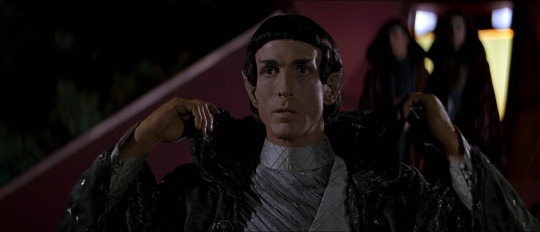
So first contact with the Vulcans happens, right? The Vulcan ship lands…
Ooh look an alien. Pointy ears!
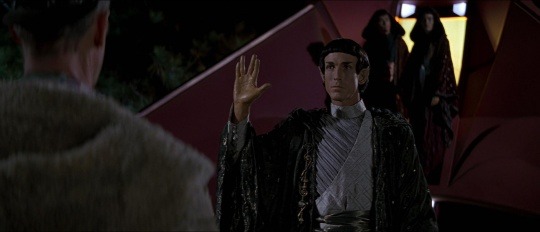
He offers what we as Star Trek fans recognize as the traditional Vulcan greeting.
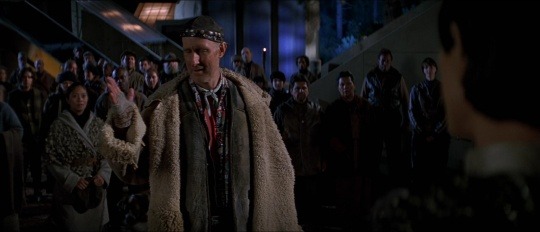
Zefram Cochrane tries to copy…
Haha he can’t do it.
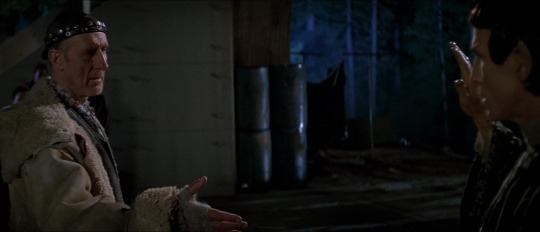
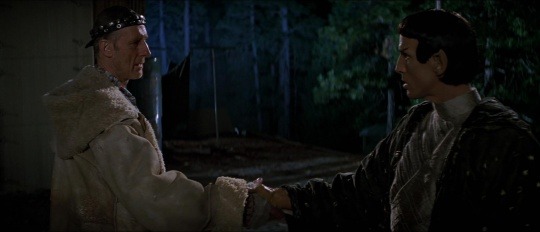
So he of course offers what he knows to be a traditional greeting, namely a handshake.
And ah yes, what a wonderful moment. Two cultures are exchanging greetings, learning about each other. It’s awesome.
Until you remember that Vulcans kiss with their hands.
So basically, this Vulcan offered a nice polite “how do you do” and Zefram Cochrane offered smoochies.
I really hope this came up in conversation later.
The Vulcans did a Kirk on the whole human race.
LET ME JUST STOP YOU ALL FOR A SECOND.
The person above was right, Vulcan’s kiss with their hands. But typically, the way they kiss only involves their index and middle finger being pressed against another person’s. That is a kiss.
In, “The Search for Spock,” you see that in the Vulcan culture, just running your fingers against someone else’s can be considered sex (the scene is super strange, but it’s heavily implied, forgive me if I’m wrong).
So, going on that thought, this isn’t just a kiss.
This is like, a make-out session, or at least a long, passionate kiss.
I just, I just can’t get over it because:
1. There are are other Vulcan’s watching these guys, but the Vulcan in front just fucking accepts the kiss.
2. This takes a second right? Like, Zefram can’t do the Vulcan salute so he offers his hand and this Vulcan just gives him this face like, “oh, um, alright? I guess I shouldn’t refuse.” And he just ACCEPTS IT.
The best thing over all is, after they connect, this Vulcan just gives this guy bedroom eyes. It’s like he’s thinking, “well, bold of you sir, bold. Such a strong grip. Perhaps we can do this again in private.”
I just…
THIS GUY.
You don’t get to be a space diplomat unless you are fully ready to fuck an alien.